Drover Cattle · Live now

Your feedlot data already knows which pens are at risk.

Upload your treatment records, feed data, and cattle movements. Drover turns them into pen risk scores, treatment intelligence, and source profiling. Powered by Helix AI. No new hardware.

Start free trial See the product
$800M–$900M1
Annual US BRD losses
USDA · Chirase & Greene, 2001 · J. Animal Science
70–80%2
Of feedlot morbidity is BRD
USDA NAHMS Feedlot '99 · Smith, 1998
$2B+4
Estimated annual BRD economic losses
Powell, 2013 · Univ. of Arkansas Extension
$0
New hardware required
Your existing CSV exports are enough
Built for the USDA EID mandate rollout — 11 million cattle entering digital infrastructure by 2027. Existing treatment data is the foundation.
USDA APHIS · Final Rule, effective November 5, 2024
Scroll
Grounded in research from
USDA Agricultural Research Service Texas Tech University NAHMS Feedlot Studies Funk et al. 2024
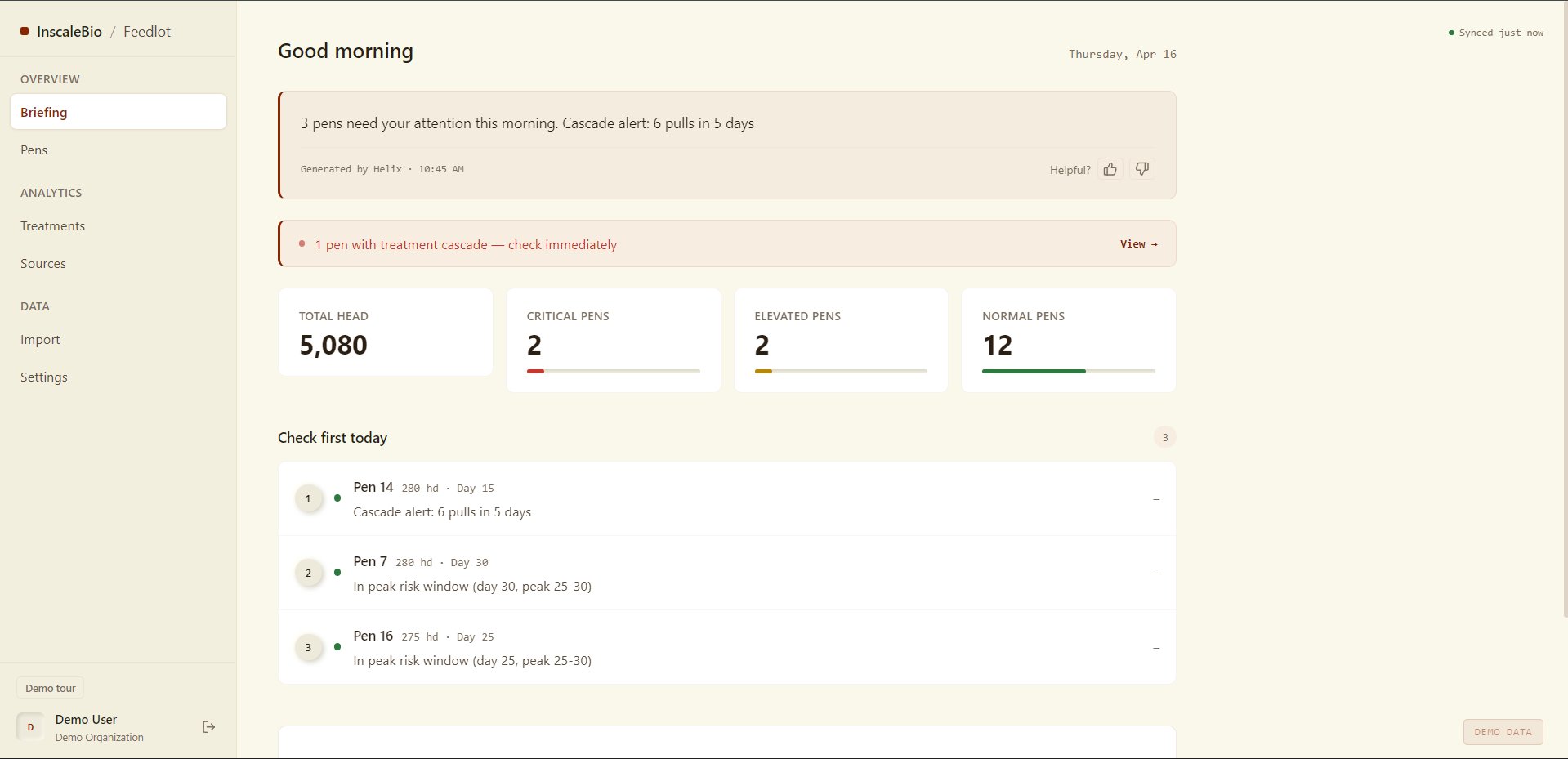
Drover Cattle · app.inscalebio.com · what you see every morning
Drover — Briefing view showing pen risk scores and daily pull list
How it works

Three steps. No hardware.

01
Upload your data
Export CSVs from Performance Beef, ITS Livestock, or your own spreadsheets. Our intelligent column mapper handles any format — mismatched headers, messy data included.
Treatment recordsFeed dataCattle inventory
02
Detection runs overnight
The 8-layer detection system correlates treatment outcomes with sources, protocols, seasons, and pen-level feed trends across thousands of head — producing risk flags your pen riders can't see manually.
Pen risk scoringProtocol effectivenessSource profiles
03
Helix explains it at 6 AM
Helix is the veterinary reasoning layer on top of detection. It takes each risk flag and produces a plain-English reason and recommendation — ready before your pen riders hit the lots.
Daily pull listAI insightsActionable dashboards

Intelligence your current software can't deliver.

Treatment Outcome Intelligence
Correlates treatment protocols with outcomes by source, arrival cohort, season, and pen. See which protocols actually work for your cattle mix.
"Protocol A has 72% first-treatment success on Smith Ranch cattle. Switching would have saved $18,400 last quarter."
Pen Risk Scoring
Flags pens where rising pull rates, declining bunk scores, and arrival cohort patterns suggest a BRD break is developing before your pen riders see it.
"Pen 14 risk elevated: bunk score down 18% over 3 days. Consistent with early BRD pattern in Smith Ranch lots."
Source Risk Intelligence
Rank every cattle source by pull rate, mortality, chronic rate, and days-to-first-treatment. One bad source can cost hundreds of thousands.
"Auction Barn C has 2.3× higher first-pull rate than ranch-direct. Estimated added cost: $47 per head."
Daily Pull List + 6 AM Digest
A ranked daily list of which pens to check first — risk score, days since last check, feed trends. In your inbox before your pen riders hit the lots.
"3 pens flagged today. Pen 14-N highest priority — check before 8 AM."
Compatibility

Export from your system. Upload to ours.

CSV & Excel Upload
Available now
Drag-and-drop any file. Column mapper auto-detects your schema and handles mismatched headers.
Performance Beef
Via CSV export
Export treatment records, feed delivery, and closeout reports. Upload directly for instant analysis.
ITS Livestock
Via CSV export
Export from feedIT and treatIT. Drover maps your columns automatically.
GrowSafe / Vytelle
Via data export
Export individual feed intake data. Drover adds health intelligence on top of precision feeding data.
AgResult & Cattler
Via CSV export
Works with any system that produces structured data files.
Spreadsheets & Custom
Universal
If your data has dates, pen IDs, treatments, and outcomes — we can ingest it.

See what BRD is costing you.

Head on feed 10,000
BRD morbidity rate 21%
Default: 21.2% · USDA NAHMS Beef Feedlot 2011 Study
Net loss per BRD case $160
Default: $160 composite · NAHMS 2011 + Griffin et al. 2010
Expected morbidity reduction 15%
Estimated. Actual reduction depends on baseline morbidity, source mix, and intervention timing.
Current annual BRD losses
$336,000
Based on 2,100 BRD cases / year
Estimated annual savings
$50,400
315 fewer cases through earlier intervention
Return on Drover Pro plan
8.4×
vs. $6,000/year Pro plan cost
Based on USDA BRD morbidity benchmarks (NAHMS Beef Feedlot 2011). Individual results vary by operation size, source mix, and management practices. Calculator inputs are cited; outputs are calculated from your inputs.

See the product →
Pricing

Between record-keeping and hardware. Exactly where you need us.

Starter
$200
per month, flat · Up to 2,000 head
  • CSV data upload
  • Pen-level risk scoring
  • Treatment outcome intelligence
  • Daily pull list
  • 6 AM email digest
Start free trial
Enterprise
Custom
$0.50–$1.00 / head / month · 10,000+ head
  • Everything in Pro
  • Direct API integrations
  • Multi-yard management
  • Custom reports & exports
  • Dedicated support
Contact us
Performance Beef charges $195/mo for record-keeping. SenseHub charges $50–200/head/mo for hardware.
We're the intelligence layer in between.
Work with us directly

Skip the self-serve setup.

We'll help you upload your data, configure pen mappings, and get intelligence flowing within 24 hours. Free during pilot.

Your data stays yours. We use anonymized aggregates to improve the product. Deletable on request.

Got it — we'll be in touch within 24 hours. Check your email for next steps.
Or try the live demo first — no account required

Your pen riders are good. Your data can make them better.

The patterns are already in your treatment records. Drover finds them so you can act on them.

Sources for figures on this page
1
Chirase, N.K. and Greene, L.W. (2001). Dietary zinc and manganese sources administered from the fetal stage onwards affect immune response of transit stressed and virus infected offspring steer calves. Animal Feed Science and Technology, 93(3–4):217–228.
2
USDA APHIS, National Animal Health Monitoring System (NAHMS). Beef Feedlot 2011 Study. Fort Collins, CO. (Morbidity benchmark: 21.2% BRD incidence.)
3
Johnson, K.K. and Pendell, D.L. (2017). Market impacts of reducing the prevalence of bovine respiratory disease in United States beef cattle feedlots. Frontiers in Veterinary Science, 4:189.
4
Powell, J.G. (2013). Bovine respiratory disease. University of Arkansas Division of Agriculture, Cooperative Extension. (Estimated total industry losses: $2B+ annually.)
5
Smith, R.A. (1998). Impact of disease on feedlot performance: a review. Journal of Animal Science, 76(1):272–274. (70–80% of feedlot morbidity attributed to BRD.)
6
Griffin, D. et al. (2010). Economic losses due to bovine respiratory disease. Veterinary Clinics of North America: Food Animal Practice. (Loss per case basis for ROI calculator default.)
7
USDA APHIS. (2024). Use of Electronic Identification Eartags as Official Identification in Cattle and Bison. Final Rule, 9 CFR Parts 71, 75, 77, 78, 86. Effective November 5, 2024.